Drop Catching: Inside the Millisecond Race
Every afternoon, US Eastern time, one of the least visible competitions on the internet plays out inside Verisign's registry systems. Thousands of deleting .com and .net names release in a batch, and specialized companies race to register the valuable ones faster than any human could click. The margin between winning and losing a contested name is measured in milliseconds. Here is how that race actually works, who the players are, and what your realistic odds look like.
What is drop catching?
Drop catching is registering a domain at the exact moment the registry releases it after deletion. It is the endgame for names that fell all the way through the lifecycle: no renewal, no restore, no expiry-auction sale, just a hard drop back into the public pool. That distinction matters commercially: an expiry-auction purchase transfers the original registration with its age intact, while a caught domain starts a brand-new WHOIS record. What survives a catch is everything outside the registry: the backlinks, the mentions, the type-in traffic.
How does the race actually work?
When pendingDelete ends, the registry purges the name during its daily processing, for .com and .net in the batch that starts around 2:00 pm US Eastern. There is no starting gun: catchers do not know the exact millisecond an individual name will clear, so they flood the registry with EPP create commands for their target list as the batch runs. The first create command to arrive after the purge wins the registration; everything earlier bounces off as unavailable, everything later bounces off as already taken. Registries cap how many connections each accredited registrar may hold, which turns raw speed into a numbers problem: more accreditations mean more simultaneous connections, more attempts per second, and better odds on each target.
Why are registrar accreditations the arms race?
Because the connection caps are per registrar, the serious catchers assembled fleets of them. DropCatch maintains more than 1,200 ICANN-accredited registrars, most existing purely to add firepower at drop time; Gname runs more than 500. Each accreditation carries real annual costs, so the fleets themselves signal how much money contested drops move. This is also why the field consolidated: casual competitors cannot outspend an accreditation army, and even GoDaddy exited the game, retiring its backorder product entirely on October 7, 2025. For a sense of scale, the daily release schedule feeds six-figure volumes of deleted names into this machinery every single day.
The major services compared
As of mid-2026, these are the standard options for a buyer who wants a dropping name caught:
| Service | Typical cost | Firepower or method | If several buyers want the name |
|---|---|---|---|
| DropCatch | $13-59 per backorder | 1,200+ registrar accreditations | Public auction among backorderers |
| NameJet / SnapNames | $69-79 minimum | Long-established catching networks; one shared inventory pool since 2020, so never order the same name on both | Auction between backorderers; seller commissions around 15% on their marketplace side |
| park.io | $99 flat, charged only on success | Polling-based catching for .io, .ly, .sh and similar ccTLDs | 10-day auction between backorderers |
| Catch.Club | Varies by name | Routes one backorder through 10+ partner platforms at once | Partner platform rules apply |
| Gname | Varies by name | 500+ registrar accreditations | Auction among backorderers |
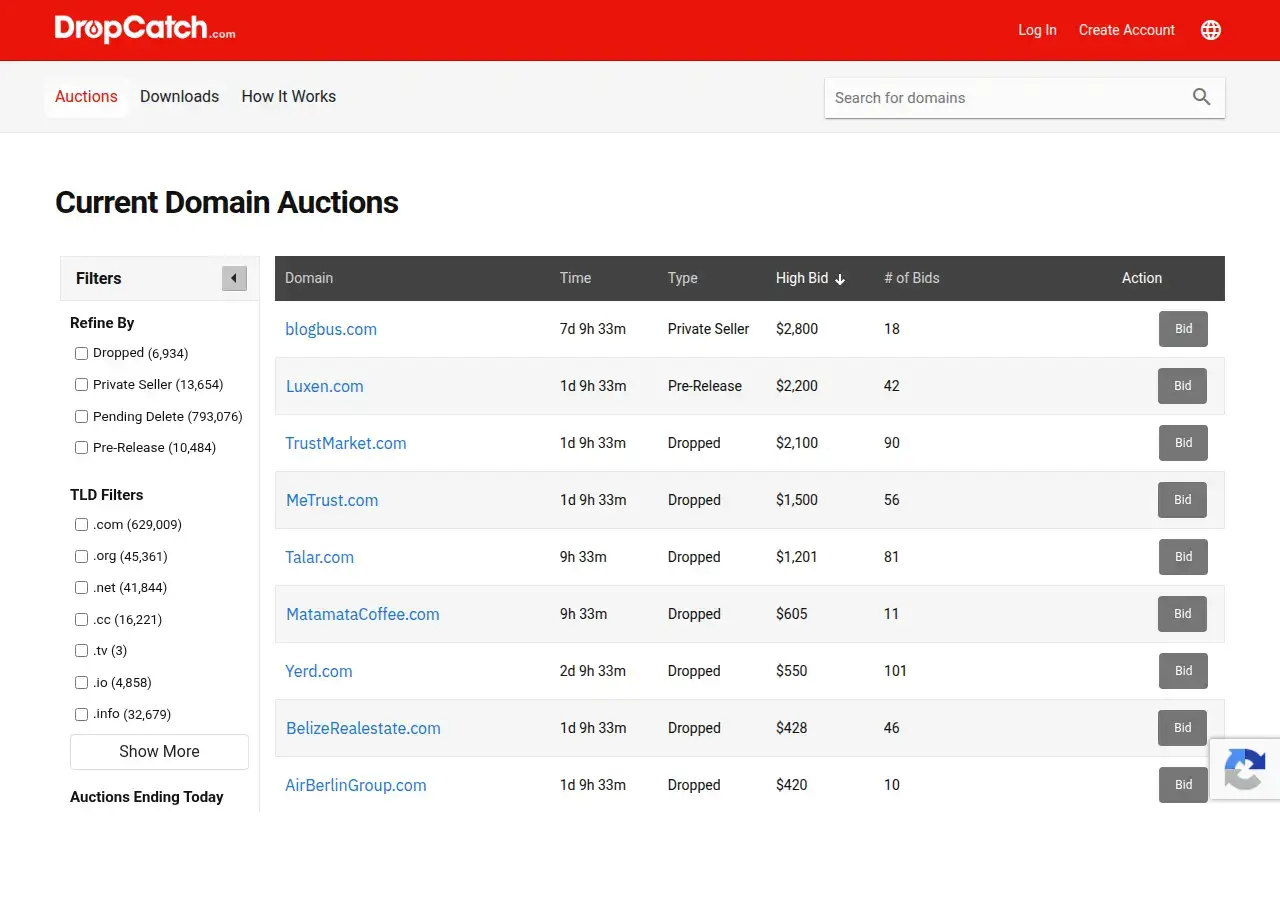
DropCatch's live auction board, where contested catches are settled between backorderers, captured August 2026
What are your real odds?
Honest answer: on a contested name, no service guarantees anything, and industry estimates put even the top catchers at 30-50% on the names they fight for. Two practical consequences follow. First, for a name you genuinely need, spread backorders across independent services, remembering that NameJet and SnapNames share one pool and count as a single shot. Second, understand that winning the catch may not end the spending: if multiple customers of the same service backordered the name, you head into an auction against them. The only free win is a name nobody else noticed, which drops quietly and can be hand-registered minutes later at your normal registrar.
What happens to caught names?
Two destinies. Names caught for a specific customer transfer to that customer, or to whoever wins the resulting auction between backorderers. Names caught on spec, by the catchers themselves, feed retail portfolios: DropCatch shares ownership DNA with HugeDomains, one of the largest buy-now domain retailers, a useful reminder that the catchers are not neutral infrastructure. They are also among the biggest buyers in the market they operate, so a name you hesitated on today can reappear tomorrow behind a four-figure buy-now price.
How do hunters decide what to chase?
The professionals never race blind; they shortlist from the pending-delete lists published days before each drop. The free route is ExpiredDomains.net, which tracks 676 TLDs with filters unlocked after registration. The paid route is an aggregator like DomCop, which layers authority scores, backlink data and spam checks onto the same daily drop lists so a shortlist takes minutes instead of evenings; annual plans work out from roughly $68 per month, there is no free trial, and a 2-day money-back guarantee applies. Either way, the research deadline is set by the backorder cutoffs, not the drop itself: orders generally need to be in before the final pendingDelete day.
ccTLDs run different races
The accreditation arms race is a gTLD phenomenon, and country registries deliberately structure their releases differently. Nominet releases expired .uk names after a roughly 90-day suspension and rate-limits registration attempts so every registrar tag gets a comparable chance, neutralizing connection floods. On .io, running on Identity Digital infrastructure, park.io built the classic polling-based catching business years ago. And .ai opted out of dropping entirely: expired names route into official daily auctions through Namecheap instead of ever reaching a public release. Before paying for any backorder, check which race, if any, your TLD actually runs.
Frequently asked questions
How fast are contested domains caught?
The winning create command lands within milliseconds of the name clearing the registry database. From a human perspective the domain goes from pendingDelete to registered with no visible gap at all.
Can an individual beat the professional drop catchers?
Not on a contested name; you cannot match 1,200 accredited registrars from a laptop. On obscure names, though, individuals win constantly: if no service was targeting it, the name sits available after the drop and a plain manual registration takes it.
What happens if two people backorder the same domain?
At most services the catch triggers an auction between the backorderers: public at DropCatch, a 10-day format at park.io. Budget for that possibility before you order, because the backorder fee is only the entry ticket.
Do backorders guarantee I get the domain?
No. A backorder is a lottery ticket in a race with an estimated 30-50% success rate on contested names, even for the strongest services. Policies on refunds differ; park.io, for example, charges its $99 only when it actually catches your name.
Why did GoDaddy stop offering backorders?
GoDaddy retired backorders and monitoring on October 7, 2025, announcing the phase-out in its help pages and directing customers toward its auction inventory instead. For drops, that leaves the specialist catchers as the practical route.